
Ancient Greek statues are among the world’s most extraordinary artistic treasures. Their graceful forms, intricate details, and timeless beauty continue to captivate travelers thousands of years after their creation.
However, these masterpieces hold secrets that go far beyond their elegant appearance. From vibrant original colors to remarkable sculpting techniques, ancient Greek statues reveal fascinating stories about mythology, beauty, and civilization.
At Skyrim Travel, we believe discovering Greece means experiencing the history behind its most iconic landmarks. Therefore, exploring ancient Greek sculpture offers a unique opportunity to connect with the country’s extraordinary cultural heritage.
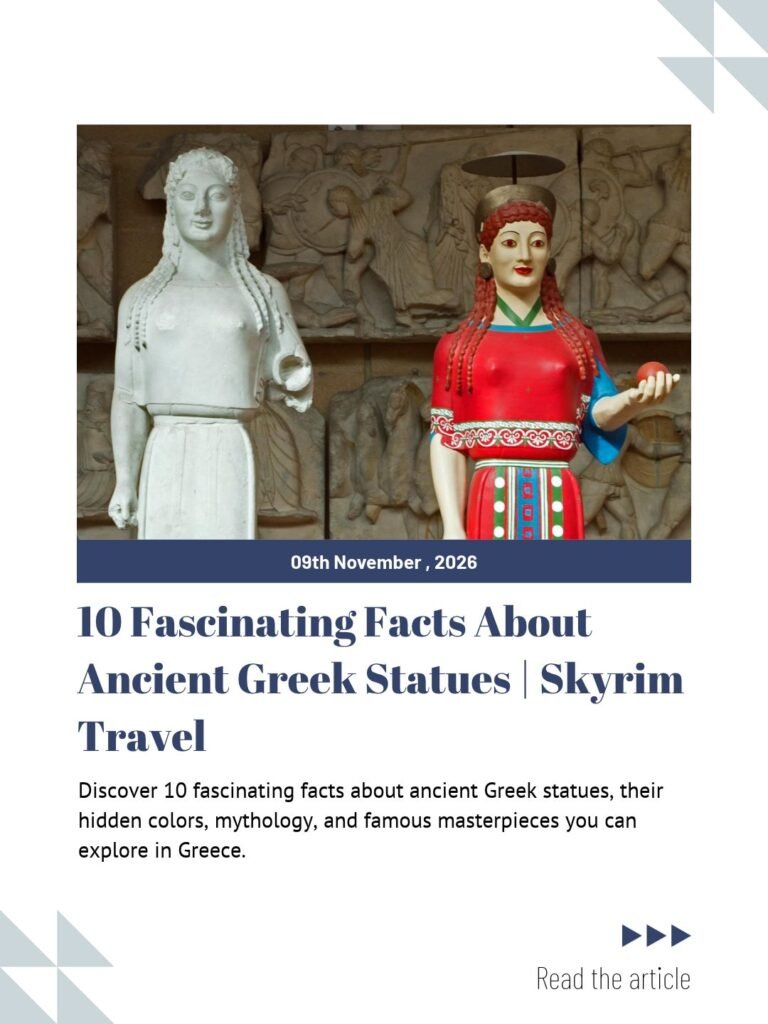
1. Ancient Greek Statues Were Once Full of Color
Most travelers imagine ancient Greek statues as pure white marble masterpieces. Surprisingly, many were originally painted in vibrant shades of red, blue, green, and gold.
This artistic technique, known as polychromy, brought sculptures to life through carefully applied pigments. Furthermore, artists used color to emphasize clothing, facial features, and decorative details.
Over centuries, exposure to environmental conditions caused much of the original paint to disappear. As a result, the elegant white statues admired today often look very different from their ancient appearance.
2. Greek Sculptors Pursued the Perfect Human Form
For ancient Greek artists, the human body represented harmony, balance, and ideal beauty.
Sculptors carefully studied anatomy and mathematical proportions to create figures that appeared both natural and extraordinary. In particular, the famous sculptor Polykleitos developed a proportional system known as the Canon.
His celebrated sculpture, the Doryphoros, became a model of idealized human proportions.
Consequently, these artistic principles influenced generations of sculptors and helped shape the foundations of Western art.
3. Many Famous Greek Statues Are Actually Roman Copies
Interestingly, several of the world’s most recognizable Greek sculptures are not original Greek creations.
During the Roman period, wealthy collectors admired Greek masterpieces and commissioned reproductions for their villas and public spaces.
Furthermore, many original bronze statues disappeared because their valuable metal was recycled.
Roman marble copies preserved the appearance of numerous lost Greek works. Therefore, much of our understanding of Classical Greek sculpture comes from these remarkable reproductions.
4. Some Ancient Greek Statues Had Realistic Eyes
Ancient Greek sculptors wanted their creations to appear remarkably lifelike.
To achieve this effect, they sometimes inserted carefully crafted eyes made from glass paste, stone, or other materials. Moreover, bronze sculptures could include contrasting metals for lips and eyelashes.
One fascinating example is the Charioteer of Delphi, whose preserved inlaid eyes contribute to its strikingly realistic expression.
Today, visitors can admire this extraordinary masterpiece at the Archaeological Museum of Delphi.
5. Bronze Was One of the Most Valuable Sculpting Materials
Although marble statues dominate modern perceptions of ancient Greek art, bronze was an important material for Greek sculptors.
Unlike marble, bronze allowed artists to create extended arms, dynamic movements, and intricate poses with greater structural freedom.
However, bronze was also extremely valuable. Consequently, countless sculptures were melted down throughout history and transformed into other objects.
One of the most impressive surviving examples is the Artemision Bronze, displayed at the National Archaeological Museum in Athens.
The statue is traditionally identified as either Zeus or Poseidon, although its precise identity remains debated.
6. Ancient Greek Statues Told Stories of Gods and Heroes
Greek mythology played a central role in ancient sculpture.
Artists created magnificent representations of Zeus, Athena, Apollo, Aphrodite, and countless mythological heroes. In addition, these sculptures communicated religious beliefs, cultural values, and legendary stories.
Some statues served as sacred images within temples and sanctuaries.
For example, the colossal statue of Zeus at Olympia was considered one of the Seven Wonders of the Ancient World.
Although the original masterpiece no longer survives, its legendary reputation continues to inspire fascination with ancient Greek art.
7. Greek Artists Revolutionized the Representation of Movement
Early Greek sculptures often featured rigid postures and symmetrical proportions.
However, during the Classical period, sculptors introduced increasingly natural body positions.
One revolutionary technique was contrapposto, in which a figure places most of its weight on one leg. As a result, the hips and shoulders shift naturally, creating a relaxed and realistic appearance.
The famous Kritios Boy, displayed at the Acropolis Museum, represents an important early example of this artistic development.
This innovation transformed sculpture and influenced Western artistic traditions for centuries.
8. Not Every Greek Statue Represented a God
Although mythology inspired many ancient masterpieces, Greek sculptors also celebrated human achievements.
Athletes, warriors, political figures, and ordinary citizens appeared in sculptures throughout the ancient Greek world.
For instance, victorious athletes sometimes received statues honoring their accomplishments. Furthermore, funerary monuments preserved the memory of loved ones.
These artworks provide valuable insight into the social traditions and everyday values of ancient Greek civilization.
Therefore, exploring Greek sculpture is also a fascinating journey into the lives of the people who shaped history.
9. Some Ancient Greek Statues Were Monumental
Ancient Greek artists were capable of creating sculptures on an extraordinary scale.
One of the most famous examples was the Colossus of Rhodes, a gigantic bronze representation of the sun god Helios.
Standing approximately 30 meters tall, this monumental statue was among the Seven Wonders of the Ancient World.
Unfortunately, an earthquake destroyed it during the 3rd century BCE.
Nevertheless, the Colossus remains a powerful symbol of ancient Greek engineering, creativity, and artistic ambition.
10. Greece Is Home to Some of the World’s Most Remarkable Ancient Statues
Today, Greece offers exceptional opportunities to discover ancient sculpture in its original cultural setting.
In Athens, the Acropolis Museum showcases extraordinary sculptures connected to the Acropolis, including the famous Archaic Korai.
Meanwhile, the National Archaeological Museum houses magnificent bronze masterpieces and marble sculptures spanning centuries of Greek history.
Beyond Athens, the Archaeological Museum of Delphi preserves the celebrated Charioteer, one of the finest surviving examples of ancient Greek bronze sculpture.
Furthermore, exploring these collections alongside nearby archaeological sites creates a deeper understanding of the civilization that produced them.
Essential cultural destinations for sculpture enthusiasts:
- Acropolis Museum, Athens: Discover iconic Classical and Archaic sculptures in a contemporary architectural setting.
- National Archaeological Museum, Athens: Admire remarkable bronze masterpieces and sculptures from across ancient Greece.
- Archaeological Museum of Delphi: Experience the extraordinary Charioteer of Delphi and treasures from the ancient sanctuary.
Discover Ancient Greek Art Through a Tailor-Made Journey
Experiencing ancient Greek statues in person is far more meaningful than simply admiring their photographs.
Every sculpture reveals a story of artistic ambition, mythology, and cultural identity. Moreover, visiting Greece’s museums and archaeological landmarks allows travelers to experience these masterpieces within the landscapes that shaped their creation.
At Skyrim Travel, we specialize in thoughtfully designed journeys that combine cultural discovery with exceptional travel experiences.
Whether you dream of exploring Athens’ remarkable museums or discovering the ancient treasures of Delphi, we can help create an itinerary tailored to your interests and personal travel style.
Ready to Explore the Timeless Beauty of Ancient Greece?
Discover Greece through its extraordinary artistic heritage, fascinating mythology, and iconic archaeological treasures.
Let Skyrim Travel design a personalized cultural journey that transforms ancient history into unforgettable experiences.
Begin Your Greek Cultural Journey Today
- Connect on Instagram: Follow @skyrim_travel and get in touch to discuss your ideal Greek escape.
- Plan Your Tailor-Made Experience: Explore personalized travel opportunities designed around your interests.
Click Here to Start Planning Your Private Greek Cultural Journey